


Miami is an interesting ecosystem to understand the dynamics of entrepreneurship and internationalization of different companies. In recent years, the city has attracted both U.S. and international founders with the ambition to position themselves in the local market. However, creating and scaling a company in Miami brings with it a set of challenges that those who have dared to start a business can share first-hand.
As Rebelius, we teamed up with the Cambridge Innovation Center (CIC) and set out to explore the common challenges faced by some CEOS and founders. We interviewed 17 Miami business leaders, systematized their responses and analyzed the most relevant themes to build the Leaders Across Borders report (download here).
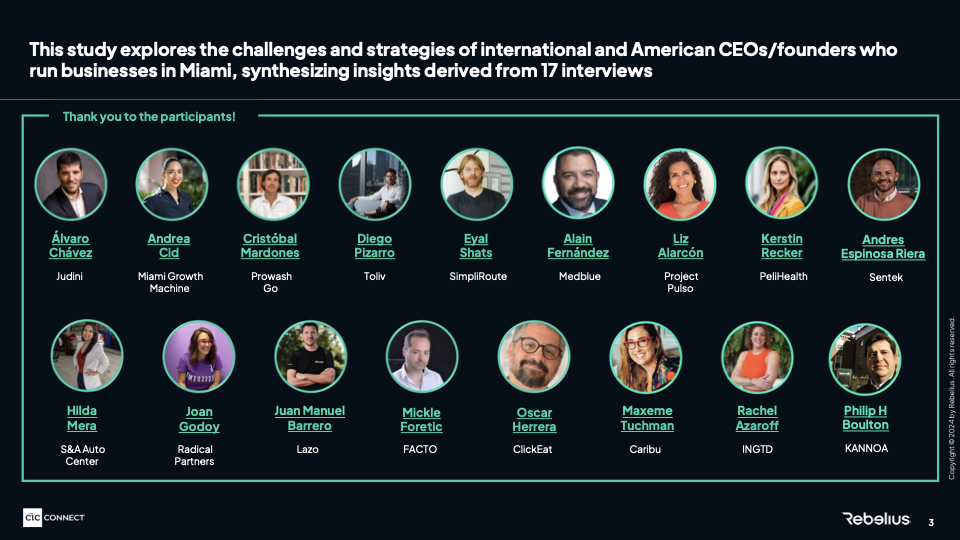
In this article we share with you some lessons from the study, which reveals operational, financial and cultural challenges that entrepreneurs face during the process of international expansion or scaling up their businesses. We invite you to download the report here.
🚀 What are the main challenges when creating or internationalizing a company
Challenge #1: Balancing technical challenges with adaptive challenges
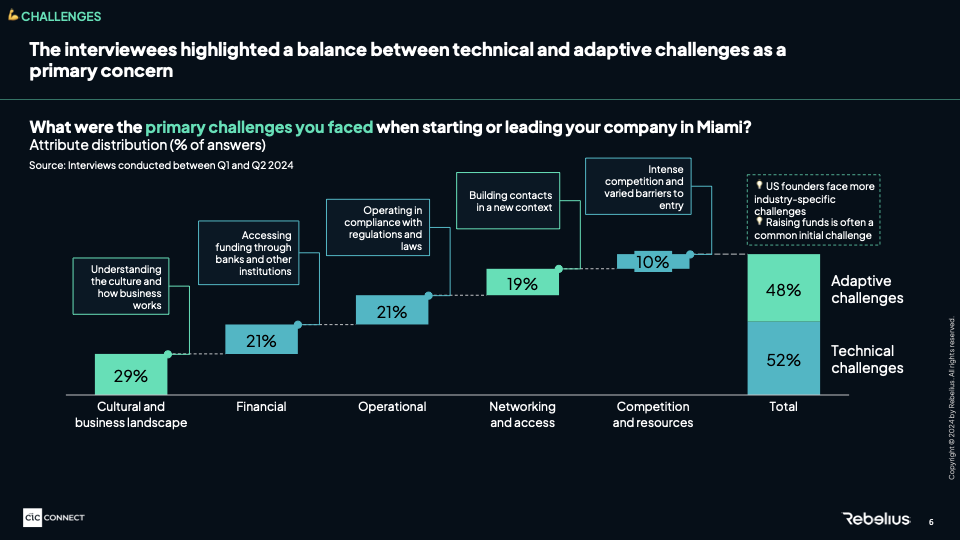
Although the CEOs and founders interviewed report that they always face several challenges simultaneously, it is observed that the main complexity is to balance the resolution of technical challenges with the adaptation to a new context in which to operate. The main challenges mentioned are:
- Addressing financial and operational issues: Accessing financing without a U.S. credit history, dealing with local regulations, sectoral laws and tax planning constitute about 40% of the challenges mentioned.
- Navigating the cultural and business landscape: Understanding the local culture and business practices in Miami is essential, especially for international founders who are unfamiliar with U.S. regulations. About 30% of the above challenges are related to this challenge.
- Accessing new networks: Creating a network from scratch, especially in a city like Miami where connections and reputation are crucial, constitutes about 20% of the challenges mentioned.
- Responding to the intensity of competition: Respondents describe Miami's competitive landscape as “fierce and with various barriers to entry,” so they point to the need to adopt deliberate strategies to gain an edge and stay competitive.
Challenge #2: taking cultural challenges seriously
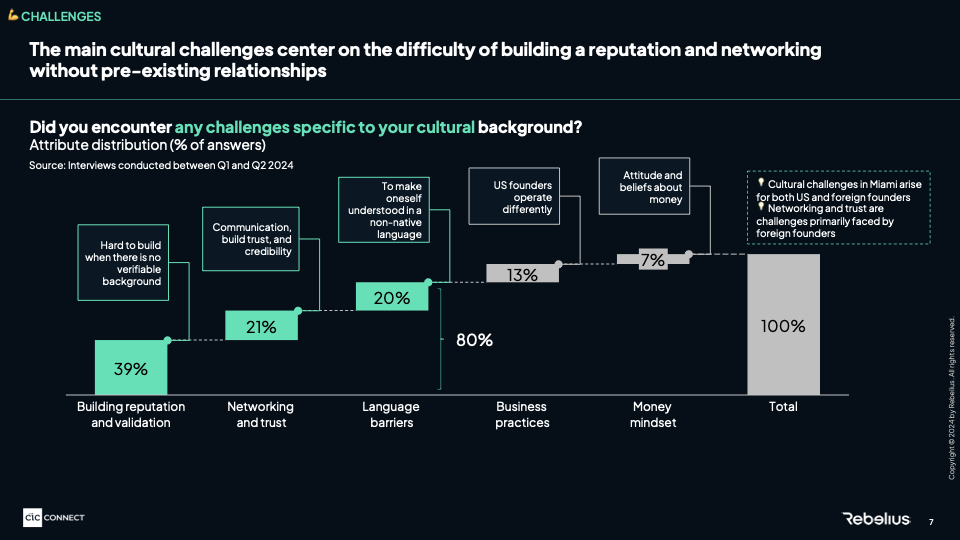
Respondents mention some cultural challenges that, while not very quantifiable, have a high impact on making or scaling a business:
- Developing personal identity: Establishing a reputation in Miami without verifiable track records can be difficult. Nearly 40% of mentions point to this as a major obstacle they faced.
- Building trusted networks: Building a network of people to trust is especially challenging for international CEOs and founders.
- Overcoming language barriers: For people who don't speak good English, language barriers can complicate collaboration and networking efforts. Twenty percent of cultural challenges are related to language gaps.
Norms, idioms and attitudes also vary from one culture to another, which is a particularly difficult aspect of entrepreneurship in Miami.
Challenge #3: Integrating into the ecosystem effectively.
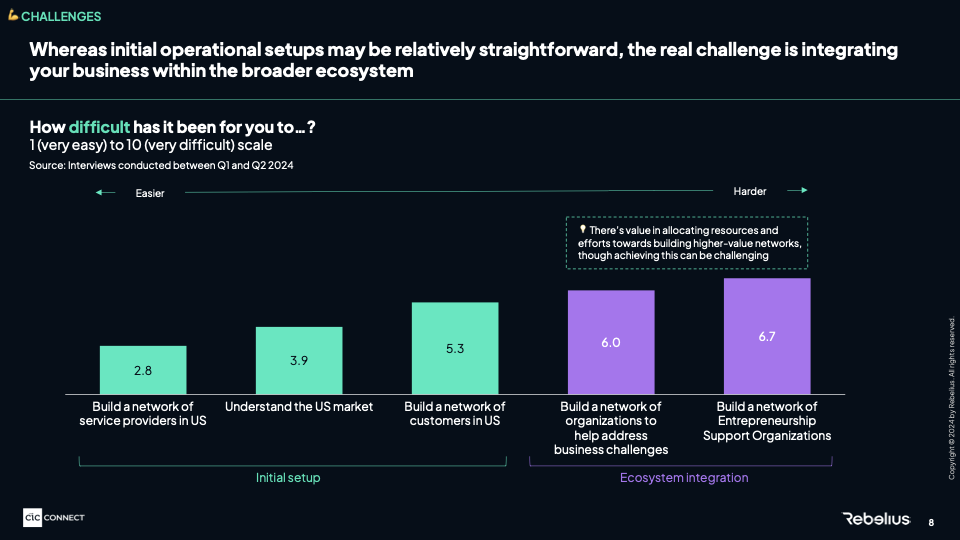
While starting operations in Miami may be similar to starting a business elsewhere, when CEOs and founders were asked to rate which elements of setting up their company they found most difficult (on a scale of 1: very easy to 10: very difficult). The conclusion is that the real challenge seems to be integrating the company into the broader ecosystem.
While it is useful to allocate resources and efforts to create higher-value networks with other organizations and entrepreneurs, the result is that relative to the initial set-up, achieving this can be much more difficult.
🚀 What do the CEOs and founders interviewed recommend to other entrepreneurs?
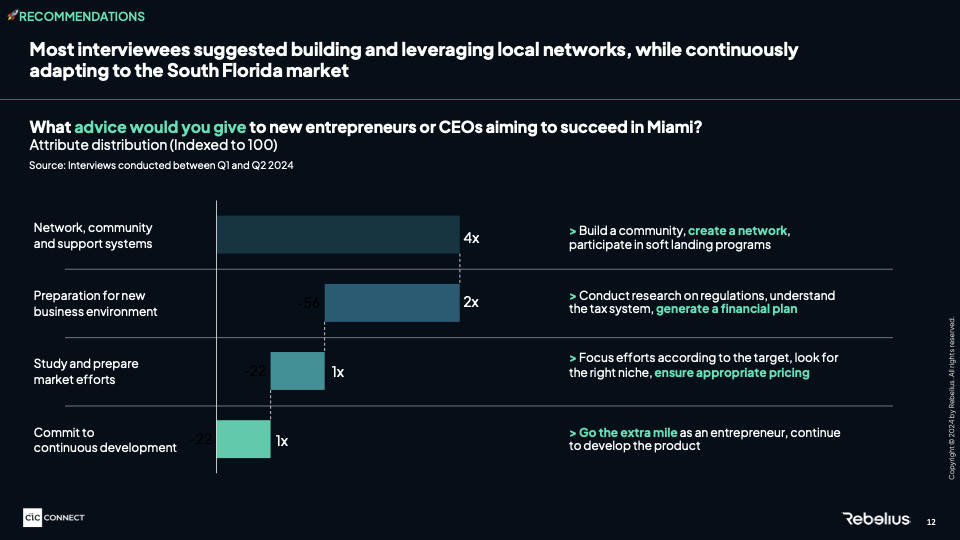
In summary, the importance of connecting with local people or organizations, along with prioritizing the work that is prior to “landing” in the local market.
Recommendations focus primarily on
- Build and leverage local networks: actively participate in local business communities. The recommendation is to attend specific events, join local groups and participate in soft-landing programs to create connections in networks other than the existing ones.
- Prepare for “landing” in a new business context: Before moving to a new market, founders recommend taking time to understand business and tax regulations, financial requirements and existing institutions. Knowing the terrain and taking the time to articulate a well-thought-out plan can be essential to avoid costly mistakes down the road.
- Study the market: CEOs and founders also recommend focusing efforts by looking for “niche customers.” In addition, take the time to understand appropriate pricing, competition and alternative or complementary offerings.
- Iterate development: Founders share the importance of continually refining their products and services, ensuring that new customer needs they observe are being addressed.
💡 The Rebel take-away: What are our findings?
The interviews with the CEOS and founders allow us to articulate 3 reflections that can be clarifying for people looking to internationalize a company.
The interviews with the CEOS and founders allow us to articulate 3 reflections that can be clarifying for people looking to internationalize a company.
1. Invisible work. Because “being present” is not enough.
CEOs and founders share that one of the keys to internationalizing a company is detailed preparation, which begins before arriving in the destination city. The preparations range from estimating the new cost structure, finding out about the appropriate legal entities, tax implications, to details of salaries and insurance requirements. In addition, there are various procedures and actions that can be taken from the city or state of origin. There are many stories of people who move to Miami to “open market” without having done a good job of preparation, only to find out that just being present does not assure closing new business or that the set-up and living costs are very high.
2. Cultivation of relationships. Because networking is not enough.
Several people interviewed told us about the initial mistake of seeking help only from close connections (especially those in their own country or state) and how this search ends up being limiting or redundant. In general, there are some “connector” people or institutions that facilitate integration into the local ecosystem. Identifying those “amplifiers” is a first step, but along with that, it is clear to us that building a network made up of different types of professionals and organizations is more than going to events and adding people to Linkedin.
3.Cultural sensitivity. The background that makes the difference.
The people interviewed note the cultural richness resulting from the diversity of people living in Miami. They tell us that some cultures tend to over-commit or have a hard time saying no, while other cultures are very direct. With some groups the perception is that it is difficult to build deeper interactions and other groups prefer to do business with people they already know. Being aware that there is a background from which different people act allows CEOs and founders to understand what is important or valued in different cultures.
--
Thank you for reading.
Rebelius consulting: Sebastián Balmaceda - Fernando Brierley - Camila Hidalgo
CIC: Alejandra Winter - Cristina Urdaneta
👏 Acknowledgments
We extend our thanks to everyone who contributed to the success of this study and to the participants for sharing their time and learning. The insights and experiences have enriched this report and we hope that the content will be useful to founders and leaders who are starting or growing their businesses in Miami.


